
Philosophy in one sentence
Reality can be understood through distinct categories of substances, qualities and relations.
Vaisheshika asks what kinds of entities a complete account of the world requires. It develops a pluralist realism, including atomic explanations of material objects, selves, non-material substances and relations such as inherence. Knowledge of their similarities and differences is linked to the highest good. Its systematic ambition is classification in the service of explanation, not simply a theory that everything consists of atoms.
Why it matters
It teaches you to notice hidden assumptions about what exists.
When you say 'the cup is blue', you have mentioned an object and a quality. Is blueness something real, merely a word, or a way the object appears? When you say 'the cup is missing', are you knowing an absence? Vaisheshika makes these ordinary distinctions philosophically explicit. Its value lies not in demanding acceptance of its entire taxonomy but in showing how explanatory language commits us to kinds of things.
Historical origin
Kaṇāda’s aphorisms developed into a detailed ontology and later joined Nyaya.
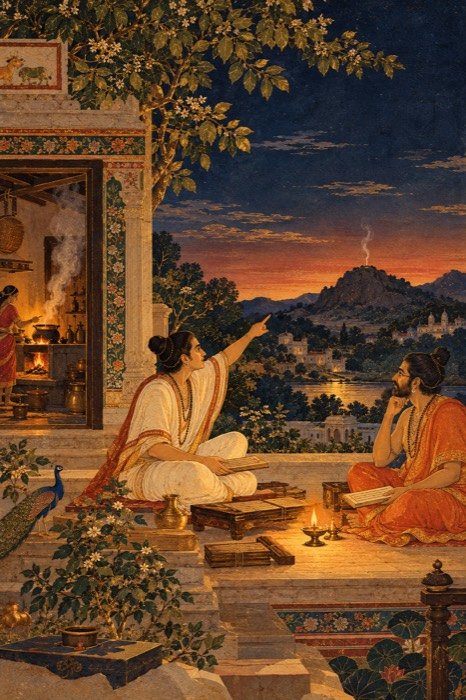
The Vaiśeṣikasūtra is attributed to Kaṇāda, whose biography and exact dates are uncertain. The text’s formation is generally located around the last centuries BCE and early centuries CE, with disputed layers. Prashastapada’s Padārthadharmasaṃgraha elaborated the system, and subsequent commentators developed it further. Its long interaction with Nyaya eventually produced a closely integrated philosophical tradition, although their original emphases were different.
Central questions
What is a substance, how do qualities belong to it, and what makes individuals distinct?
Can qualities exist without something qualified? Are wholes more than collections of parts? What explains similarity between different objects? What makes two ultimate atoms or selves numerically distinct? How do we know an absence? These questions reveal why an atomic theory alone would not complete the system: a world also needs an account of properties, kinds, relations, motion and knowing subjects.
Core ideas
Its categories separate substances, qualities, actions, universals, particularity and inherence.
Substances bear qualities and actions. Universals explain commonality, while ultimate particularity distinguishes otherwise similar eternal entities. Inherence accounts for inseparable relations such as that between a whole and its parts or a quality and its substance. Later authors give absence independent categorical status. The standard substance list includes earth, water, fire, air, ether, time, space, self and mind; not all of these are atomic.
View of reality
A real world contains both material and non-material entities.
Material things can be analysed through combinations of enduring atoms of earth, water, fire and air. Yet ether, space, time and selves are not reducible to those material atoms. Wholes and their properties require explanatory relations beyond simple aggregation. The system therefore combines atomism with a richer metaphysical inventory. It is neither modern materialism nor merely a symbolic description of spiritual experience.
View of the Self
Selves are enduring substances; cognition is one of their qualities.
The conscious life of a person requires a self distinct from body and the internal organ called mind. Cognition, pleasure, pain, desire and effort arise under suitable conditions and indicate the presence of a subject. The enduring self is not equated with an unchanging stream of consciousness; episodes of knowing are qualities. This sharply distinguishes the system from Advaita and also exposes it to Buddhist criticisms of enduring substances.
View of God
Later Vaisheshika integrates a divine governor; the earliest text is less straightforward.
In its developed interaction with Nyaya, Vaisheshika includes Īśvara in the account of cosmic order, with atoms and souls retained as real enduring entities. The historical role of God in the earliest sūtras is disputed. A responsible overview therefore marks theism as characteristic of the developed tradition without making the initial text a simple creation theology. Atomic causation and divine governance operate at different explanatory levels.
Cause of suffering
Misunderstanding and action bind a real self to painful embodiment.
Within the school’s karmic framework, the self undergoes pleasure and pain through embodiment and activity conditioned by ignorance and moral dispositions. Knowledge of reality supports the removal of the conditions sustaining bondage. The classification of categories thus serves more than detached curiosity: it is linked to a transformed understanding of the person’s situation. Still, a catalogue of entities alone is not an immediate remedy for every form of distress.
Path to liberation
Knowing reality helps end the conditions for suffering and rebirth.
The highest good is connected with knowledge of the similarities and differences among categories. In the integrated Nyaya–Vaisheshika account, false knowledge and the activities it supports must cease. Liberation is frequently characterised through freedom from the body and painful experience, with difficult questions about its positive content. If the liberated self no longer has ordinary cognition, critics ask what makes that state valuable beyond the absence of suffering.
Ethics and everyday life
Clear distinctions can support responsible judgement, but classification is not moral ranking.
The system’s careful analysis encourages asking what exactly is being predicated of whom, and on what grounds. A modern application is to distinguish a person from a temporary attribute or action without denying responsibility for the action. The metaphysical notion of viśeṣa does not license social superiority, and the categories should not be used as a hierarchy of human worth. Historical social assumptions deserve their own critical discussion.
A simple real-life analogy
A ceramic cup, its colour and its motion are not the same kind of thing.
You can pick up the cup, notice its brown colour and watch it move across a table. Substance, quality and motion play different explanatory roles. The fact that another cup is also a cup raises a question about universals, and a missing cup raises a question about absence. This everyday scene illustrates why the school proposes multiple categories. It does not settle whether universals or inherence exist independently of our descriptions.
Arguments supporting the philosophy
The variety of ordinary judgements suggests that one category cannot do all explanatory work.
Qualities appear to require bearers; similarity seems to require something common; wholes exhibit structures not captured by naming isolated parts. Vaisheshika gives each role a place in its ontology. Its atomism also seeks stable bases for material change. The system’s strength is explanatory organisation. Critics ask whether this organisation reflects reality itself or only the structure of language and thought.
Criticisms and philosophical problems
Universals and inherence may solve one problem while creating another.
If a quality is linked to a substance by inherence, what explains that relation’s own connection to its terms? Does this invite a regress? If universals are real, how does one universal occur in many places? Can atoms without parts coherently combine into extended wholes? Buddhist and other critics pressed these issues. Vaisheshika’s replies rely on treating some relations and entities as fundamental, a move that itself needs justification.
Disagreements with other Indian schools
Its realism opposes Buddhist nominalism and Advaita’s ultimate non-duality.
Many Buddhist philosophers deny real universals and enduring substances, offering alternative accounts of similarity and causal continuity. Advaita does not grant the categorical plurality ultimate independence. Samkhya explains change through transformation of one nature and pre-existent effects, unlike the production account associated with Nyaya–Vaisheshika. Jainism also develops categories and atomism but embeds them in a different theory of living souls and karma.
Common misconceptions
Ancient atomism is not a prediction of every discovery in modern science.
The theory is historically important without being recast as quantum mechanics. It contains non-material substances and a soteriological project foreign to contemporary physics. Its technical use of karma can mean motion, not moral retribution; guṇa here means quality, not precisely Samkhya’s three constituents. And the familiar seven categories are the result of development, not necessarily a list asserted unchanged by every early author.
Key thinkers
- Kanada — Traditional founder; exact dates unknown
- Prashastapada — c. 5th–6th century CE
- Shridhara — c. 10th century CE
Sanskrit and Pali terms
- Padārtha
- A category of knowable reality.
- Dravya
- Substance: a bearer of qualities and motion.
- Guṇa
- Quality; a different technical use from Samkhya’s guṇas.
- Karma
- Motion or action as an ontological category; distinguish moral karma.
- Sāmānya
- Universal or common nature.
- Viśeṣa
- Ultimate particularity.
- Samavāya
- Inherence, an inseparable relation.
- Abhāva
- Absence; made a separate category in later systematic accounts.
Sources and further reading
- Original textSanskrit transliteration
Kaṇāda: Vaiśeṣikasūtra (opens in a new tab)
GRETIL · Göttingen State and University Library
How to read itNozawa Masanobu’s electronic text. Sūtra numbering varies by recension. Read the opening discussion of dharma and categories with this caveat.
- University guideEnglish
Nyāya–Vaiśeṣika — IGNOU teaching unit (opens in a new tab)
IGNOU · public university, India
How to read itAn introductory teaching unit on knowledge, causation, categories and liberation. Read its historical attributions alongside the more cautious dates in the biographies.
- University guideEnglish
Indian Metaphysics — IGNOU unit 2 (opens in a new tab)
IGNOU · public university, India
How to read itComparative teaching material spanning materialism, realism and Vedānta. Broad classifications simplify historical diversity.