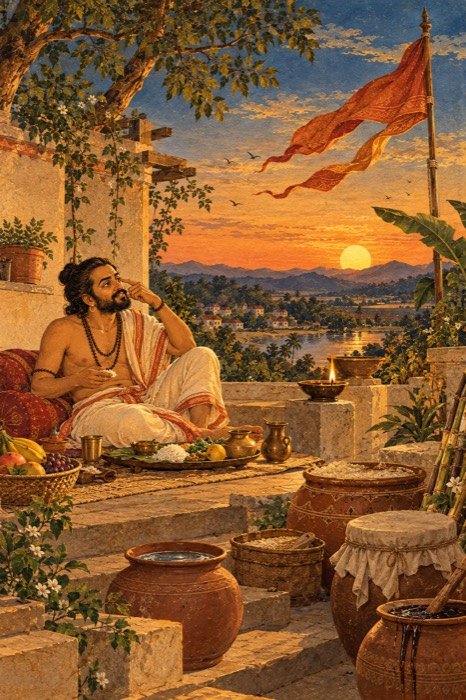
Philosophy in one sentence
Consciousness and nature are fundamentally different, and freedom comes from discerning them.
Classical Samkhya distinguishes many conscious witnesses, puruṣas, from prakṛti, the non-conscious source of both mind and matter. Bondage arises when the functions and changes of nature are attributed to the witness. Discriminative knowledge brings kaivalya: recognition of the witness’s independence. This is a dualism of consciousness and nature, not simply a contrast between the physical body and a thinking mind.
Why it matters
It makes the surprising claim that even your thoughts are not consciousness itself.
When an emotion appears, there is the emotion and its being known. Samkhya treats thoughts, decisions and the sense of 'I' as objects within nature, while consciousness is what makes their manifestation possible. This offers a disciplined way to question identification with mental activity. Yet distinguishing an experience from knowing it does not automatically establish two independent metaphysical realities. The theory invites examination of that further step.
Historical origin
The tradition is associated with Kapila; its surviving classical synthesis is by Īśvarakṛṣṇa.
Samkhya ideas developed over a long period in dialogue with epic, medical, Buddhist and other intellectual traditions. Kapila functions as a foundational sage, but his biography cannot be securely reconstructed. Īśvarakṛṣṇa’s Sāṃkhyakārikā, commonly placed around the fourth or fifth century CE, summarises the system in memorable verses. Commentaries such as the Yuktidīpikā and later works by Vachaspati Mishra and Vijnanabhikshu preserve further debate.
Central questions
What distinguishes experience from its witness, and what would end suffering permanently?
The Kārikā begins from threefold suffering and the inadequacy of remedies that are partial or temporary. It asks what can provide a definitive release. Its response requires answers about causation, the existence of an unmanifest source of change, the plurality of witnesses, and the relation between an inactive consciousness and an active world. These are not separate curiosities: each supports the proposed path of discriminative knowledge.
Core ideas
Twenty-five principles explain nature’s development and the distinct conscious witness.
The classical scheme includes prakṛti, intellect, ego-function, mind, the sensory and action capacities, subtle elements, gross elements, and puruṣa. Prakṛti operates through three guṇas: illuminating balance, activity and inertia, commonly called sattva, rajas and tamas. The effect is held to exist potentially in its cause, so transformation unfolds capacities rather than producing being from sheer nothing. Puruṣa is neither a product nor a productive cause in this material sequence.
View of reality
Nature is real and transforms; consciousness is real and does not transform.
Prakṛti is inferred as the common unmanifest ground of diverse conditioned phenomena. Its transformations include subtle mental functions as well as gross physical forms. Puruṣa is irreducible to that process. The world is therefore not an illusion in the Advaitic sense, and it is not created from nothing by a divine will in classical Samkhya. Its evolution is explained in relation to the experience and liberation of conscious beings.
View of the Self
The true self is a witness, and there are many witnesses.
Puruṣa is conscious but does not think, choose or act in the way the ordinary person does. Those operations belong to buddhi, ahaṃkāra and other aspects of prakṛti. The apparent agent results from their association. Samkhya argues for a plurality of puruṣas using the distinct patterns of birth, death and experience. Unlike Advaita, it does not take all selves to be one ultimate awareness.
View of God
A creator God is not needed in the classical explanatory scheme.
The classical Kārikā explains the world through prakṛti and puruṣa without assigning creation to Īśvara. This makes its system non-theistic, though it does not follow that every historical use of Samkhya was anti-religious or that it rejected all traditional cosmology. Later thinkers sometimes harmonised it with theism. The cautious claim is that a creator does not do the explanatory work in its central classical formulation.
Cause of suffering
Confusing nature’s changing states with the witness produces bondage.
Bodily pain, external adversity and larger environmental or unseen conditions exemplify the threefold suffering with which the text begins. Ordinary remedies can relieve particular troubles but do not secure final freedom. The deeper issue is non-discrimination: the witness appears bound to the operations of nature. Discerning their difference ends that attribution. This does not make practical remedies worthless; it distinguishes temporary relief from the tradition’s stronger goal.
Path to liberation
Discriminative knowledge discloses the witness’s independence.
The path centres on understanding the principles of reality sufficiently to separate puruṣa from prakṛti. Nature is said to cease its activity for the liberated witness once its purpose is fulfilled, although the world continues for others. Existing embodiment may persist for a time, like a potter’s wheel that keeps turning after the initial push. Kaivalya is not the joining of two substances or the creation of a new consciousness.
Ethics and everyday life
Discernment requires attention to habits, attachment and the quality of judgement.
Classical Samkhya gives greater systematic attention to metaphysics than to a standalone manual of social ethics. It nevertheless situates knowledge within a moral and karmic world. A contemporary application is to observe a mental state without immediately defining the whole self by it. The observation can create room for responsible action; it is not an excuse to say 'nature did it' and evade consequences. The empirical agent remains within the causal field being explained.
A simple real-life analogy
A film changes continuously while its illumination makes every scene visible.
A screen analogy can help distinguish changing content from the condition in which it appears. For Samkhya, thoughts and perceptions belong to the changing side, while witnessing consciousness does not become each event it reveals. But a literal lamp or projector is still a material object and has causal activity, unlike the puruṣa of the theory. The illustration clarifies a distinction; it does not establish an immaterial witness.
Arguments supporting the philosophy
It argues from organised experience, causation and the distinction between subject and object.
Composite things seem to function for something beyond their own aggregation; Samkhya takes this as support for a witness. The contrast between known objects and knowing motivates an irreducible consciousness. Regularity in transformation supports an unmanifest material cause in which effects exist potentially. Distinct embodied histories support many puruṣas. Each argument aims to explain experience through a small number of foundational principles.
Criticisms and philosophical problems
The relation between inactive consciousness and unconscious nature is difficult to explain.
If puruṣa does nothing, why does association with it matter? If prakṛti is unconscious, why does it appear to pursue a witness’s liberation? If all puruṣas lack differentiating material properties, what makes them many? Critics also question whether satkāryavāda follows from examples of ordinary transformation. Samkhya’s replies use proximity, reflection and the distinction between apparent and actual agency, but the explanatory burden remains substantial.
Disagreements with other Indian schools
It differs from Advaita on plurality, Yoga on Īśvara, and materialism on consciousness.
Advaita rejects two ultimately independent principles and the ultimate plurality of witnesses. Classical Yoga adopts much of Samkhya’s framework but gives a special puruṣa, Īśvara, a role in practice. Buddhist traditions question permanent witnesses, while Charvaka rejects a consciousness independent of the living body. Nyaya disagrees with the thesis that the effect already exists in its material cause.
Common misconceptions
Samkhya is neither modern physics nor the claim that the mind is the soul.
Its principles are philosophical categories, not experimentally discovered particles. In this system the mind is subtle nature, while consciousness is distinct. Sattva, rajas and tamas should not be reduced to rigid labels for ranking people. Nor does non-theism mean the school shares every commitment of modern secular naturalism. Reading the actual structure reveals why it has influenced Yoga while remaining a distinct system.
Key thinkers
- Kapila — Traditional foundational sage; dates uncertain
- Ishvarakrishna — c. 4th–5th century CE
- Vachaspati Mishra — c. 9th–10th century CE
Sanskrit and Pali terms
- Puruṣa
- Conscious witness; many, inactive and distinct from nature.
- Prakṛti
- Unmanifest nature, the source of mental and material change.
- Guṇa
- Constituent tendency of nature: sattva, rajas or tamas.
- Buddhi
- Discriminating intellect, a product of nature.
- Satkāryavāda
- The effect exists potentially in its material cause.
- Kaivalya
- Isolation or independence of consciousness from nature.
Sources and further reading
- Original textSanskrit transliteration
Īśvarakṛṣṇa: Sāṃkhyakārikā (opens in a new tab)
GRETIL · Göttingen State and University Library
How to read itElectronic scholarly text collated by Ferenc Ruzsa. Consult the edition notes and variants. Key verses: 1–4, 9, 17–21 and 59–68.
- Archive scanSanskrit and English
The Sāṅkhya Kārikā — 1837 edition (opens in a new tab)
Digital Library of India / Ministry collection · Internet Archive mirror
How to read itColebrooke’s translation with Wilson’s presentation of commentary, 1837. A historical printed edition, not an original manuscript. Older translations require comparison with modern scholarship.
- University guideEnglish
Indian Metaphysics — IGNOU unit 2 (opens in a new tab)
IGNOU · public university, India
How to read itComparative teaching material spanning materialism, realism and Vedānta. Broad classifications simplify historical diversity.