Philosophy in one sentence
God, souls and the world form one reality without losing their real distinctions.
Vishishtadvaita understands Brahman as a unified reality qualified by conscious souls and non-conscious nature. Rāmānuja identifies this supreme reality with Nārāyaṇa, possessing unsurpassed auspicious qualities. Individuality and the world are real, yet exist in complete dependence on God. Liberation fulfils the soul’s relationship with the divine; it does not erase the soul into an undifferentiated absolute.
Why it matters
It asks whether belonging to a greater whole requires losing who you are.
Many people experience a tension between individuality and belonging. Rāmānuja’s answer preserves both: a self can depend entirely on a larger reality without being a mere illusion. His account also treats the world as meaningful for devotion and action. For a questioning reader, the important challenge is not just whether this is emotionally appealing, but whether dependence and distinction can coherently belong to one ultimate reality.
Historical origin
Rāmānuja developed a Vedānta shaped by Sanskrit reasoning and Tamil devotional traditions.
Rāmānuja worked in South India during the eleventh and twelfth centuries. His tradition drew on earlier Vedānta interpreters, Yamunacharya and the devotional world of the Āḻvārs. The Vedārthasaṃgraha and Śrībhāṣya defend his reading of scripture against rival systems. Later teachers, including Vedanta Desika and Pillai Lokacharya, developed theology, interpretation and the account of surrender. Differences over grace and practice later became associated with distinct Śrīvaiṣṇava lineages.
Central questions
How can reality be one if selves and the world are genuinely different?
Does knowledge always reveal something with qualities? Can the world be real without being independent of God? What joins a finite knower to an infinite Lord? If grace is essential, why do effort and moral responsibility matter? Rāmānuja’s system makes these interconnected questions. A satisfactory explanation of unity must preserve the differences that perception, ethical agency and scriptural language seem to disclose.
Core ideas
Conscious selves and matter are distinct, real and inseparable from Brahman.
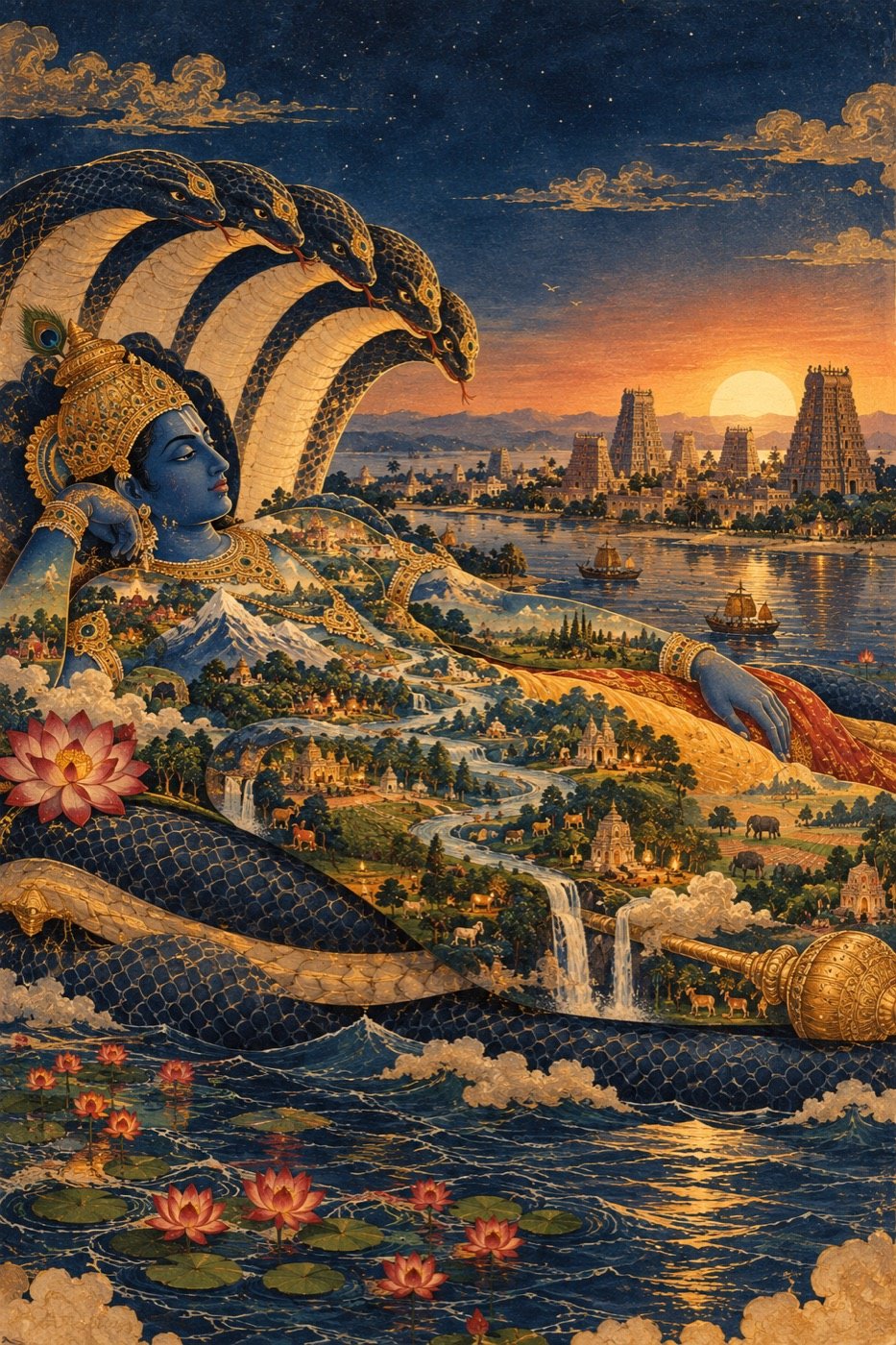
Cit denotes conscious beings; acit denotes non-conscious nature. Brahman is their indwelling controller and support. The body–self relation expresses a dependence in which the dependent reality exists for and is sustained by its inner self. The world and souls thus qualify Brahman without exhausting divine being. Knowledge is always of something determinate, and scriptural statements of unity must be interpreted alongside statements of difference and divine qualities.
View of reality
The world is real and dependent on Brahman.
The plurality encountered in experience is not a basic deception. Nature undergoes real changes while Brahman, as its inner ruler, is not reduced to the limitations of each changing state. The system gives divine causality both an intimate and a transcendent character: God is not an external artisan working on wholly independent stuff. The challenge is to explain how real worldly change and suffering belong within divine embodiment without corrupting divine perfection.
View of the Self
Each soul is real, conscious and enduring, even in liberation.
The jīva is a genuine individual subject, dependent on Brahman but not numerically identical to the Lord or to every other soul. It knows, acts and experiences the results of action. Consciousness is inseparable from its nature, with the scope of knowledge described as contracted in bondage and expanded in liberation. A freed soul does not lose the possibility of a loving relationship, because the distinction required for that relationship endures.
View of God
Nārāyaṇa is the personal, infinitely qualified Brahman.
God possesses knowledge, power and goodness without the limitations that qualify embodied beings. Rāmānuja interprets scriptural negations as denying imperfections, not removing every positive divine quality. God indwells and sustains the world, while remaining more than any finite part of it. Devotion therefore has an ultimate object rather than a merely preparatory symbol. This is robust theism, though its intimate account of divine–world relation differs from a picture of an entirely external creator.
Cause of suffering
Karma, ignorance and misdirected attachment obscure the soul’s dependence on God.
Bondage involves the embodied soul’s karmic history and failure to understand its true relationship to Brahman. Ignorance does not create an ultimately nonexistent individual; it distorts the understanding of an individual who is real. Desire and action sustain rebirth. Grace and disciplined reorientation offer release. This account must not be used to infer another person’s past actions from their present hardship: such a judgement exceeds the evidence and can excuse failures of compassion.
Path to liberation
Knowledge, devoted practice and divine grace culminate in loving participation.
The path joins ethical action, knowledge of the soul’s dependence, sustained devotion and grace. Later Śrīvaiṣṇava traditions articulate prapatti, surrender, with differing accounts of its relation to disciplined effort. Moksha preserves individual existence and the enjoyment or service of God, free from karmic bondage. The goal is not simply a more successful worldly life. Nor can one reduce the entire history of the school to a single technique of devotion.
Ethics and everyday life
Service and responsibility can express the soul’s relationship to the whole.
An act of care can be understood as service within a world sustained by the divine. Duty and devotion are not necessarily competitors: intention can reorient ordinary work. A useful reflection is to ask what changes when achievement is no longer treated as proof of total self-sufficiency. This contemporary application does not erase historical restrictions in religious institutions. A free educational platform can describe those restrictions and the challenges to them without making them conditions of access.
A simple real-life analogy
A living body is one whole whose distinct members remain real.
Your hand is not your entire person, yet it belongs to an organised living whole. Rāmānuja’s body–self analogy similarly preserves distinction, dependence and unity. It helps prevent two misunderstandings: that every soul is an independent rival to God, or that the individuality of souls is an illusion. The analogy is limited: God is not spatially trapped in a physical body, and the universe does not mechanically constrain God as an injury constrains an embodied human.
Arguments supporting the philosophy
Real difference and meaningful qualities support a qualified unity.
Everyday knowledge ordinarily distinguishes a knower, an object and the object’s features. Rāmānuja argues that a wholly qualityless object cannot explain the determinacy of knowing and speech. He also reads scripture as affirming both unity and difference. A whole qualified by real souls and matter aims to respect both sets of passages. The strength is its refusal to dismiss the plurality that argument itself uses. The unresolved question is whether the proposed divine whole is established by those premises.
Criticisms and philosophical problems
Critics ask how divine perfection can include a suffering world.
If the world is God’s body, why does it contain cruelty and suffering? If souls act only through divine support, what makes their responsibility meaningful? If Brahman is one reality qualified by differences, does non-duality still mean anything stronger than dependence? The tradition develops replies through distinctions between ruler and ruled, agency and support, and karma and grace. Each reply clarifies the system but also generates further questions about freedom and divine responsibility.
Disagreements with other Indian schools
It rejects Advaita’s ultimate sublation of difference and Dvaita’s stronger separation.
Against Advaita, Rāmānuja insists that qualities and plurality are not ultimately dismissed. Against a purely external creator model, souls and matter are constitutively related to Brahman. Dvaita agrees that persons and God remain distinct but resists the specific qualified unity of Rāmānuja. Buddhist no-self theories challenge the enduring individual soul, while Charvaka challenges the supernatural commitments. Agreement about the value of ethical practice does not resolve these metaphysical disputes.
Common misconceptions
Qualified unity is neither a halfway Advaita nor a claim that every object is the whole of God.
The qualification in Vishishtadvaita refers to real structure within unity, not to imperfect success at non-duality. Souls do not vanish at liberation. Devotion is not presented as an alternative to reasoning; Rāmānuja’s work is extensively argumentative. Nor does the body metaphor imply that any private impulse carries divine authority. The tradition’s philosophical claims, scriptural commitments and institutional history need to be distinguished.
Key thinkers
- Yamunacharya — c. 10th–11th century CE
- Ramanuja — 11th–12th centuries CE
- Vedanta Desika — 13th–14th centuries CE
Sanskrit and Pali terms
- Viśiṣṭādvaita
- Non-duality of a qualified whole.
- Cit
- Conscious selves.
- Acit
- Non-conscious reality.
- Śarīra–śarīrin
- Body and indwelling self; a model of dependence on Brahman.
- Bhakti
- Loving devotion informed by knowledge.
- Prapatti
- Surrender or taking refuge in God.
Sources and further reading
- Original textSanskrit transliteration
Rāmānuja: Vedārthasaṃgraha (opens in a new tab)
GRETIL · Göttingen State and University Library
How to read itRāmānuja’s own philosophical interpretation of the Upanishads. This is primary evidence for his argument, not an Upanishad itself.
- University guideEnglish
Rāmānuja — IGNOU unit 14 (opens in a new tab)
IGNOU · public university, India
How to read itA teaching introduction to Rāmānuja’s realist account of knowledge and metaphysics. Read critically alongside his own work.
- Original textSanskrit; English and Indian languages
Bhagavad Gita — Sanskrit with selectable translations and commentaries (opens in a new tab)
IIT Kanpur · public institute, India
How to read itChoose the Gita reader, then select the translator and commentator. Their interpretations differ. A commentary is not the root verse.