Philosophy in one sentence
Ultimately, ātman and Brahman are not two.
Advaita argues that the awareness by which anything is known is not ultimately separate from Brahman, the limitless ground of reality. Our ordinary sense of being an isolated, changing person rests on a confusion between awareness and the body–mind. Liberation is the removal of this confusion through knowledge, rather than the production of a new eternal condition.
Why it matters
It asks whether your identity can be reduced to your changing roles and thoughts.
Your profession can change, a relationship can end, and a belief about yourself can dissolve. Advaita asks whether the knowing subject is exhausted by any of these descriptions. Its distinction between what is experienced and the awareness of experience provides a rigorous way to interrogate identity. But moving from that distinction to a single ultimate reality requires additional arguments. The appeal of the question should not be mistaken for proof of the answer.
Historical origin
Shankara systematised an older stream of Upanishadic interpretation.
The early Upanishads contain varied teachings about self, knowledge and ultimate reality. Centuries later, Gaudapada’s verses on the Māṇḍūkya Upanishad developed a radical non-origination account. Shankara, usually placed around the eighth century CE, defended non-duality through commentaries and independent teaching. Sureshvara and subsequent authors continued the tradition. Later Bhāmatī and Vivaraṇa streams disagree about aspects of ignorance and cognition; modern Advaita is likewise not one uniform voice.
Central questions
What is the Self, and can knowledge free us from mistaken identity?
Advaita asks: What remains constant through changing experience? Can awareness be known as an object? How can a world of difference appear if reality is non-dual? If bondage is due to ignorance, what kind of knowing removes it? Why does suffering continue after conceptual understanding? These questions join epistemology to liberation: an adequate account must explain both the reliability of everyday experience and the possibility of correcting its deepest interpretation.
Core ideas
Awareness is confused with body and mind; inquiry aims to undo that confusion.
Adhyāsa is superimposition: we attribute the body’s limits, the mind’s changes and the ego’s agency to the Self, while lending the Self’s conscious presence to those objects. Avidyā names the underlying misapprehension. Brahman is not another object within the world. The distinction between empirical and ultimate standpoints allows everyday causation, ethics and worship to function without treating multiplicity as independently ultimate. Mahāvākyas, major Upanishadic statements, are interpreted as disclosing the identity of self and Brahman.
View of reality
The world is experienced and consequential, but has no independent ultimate existence.
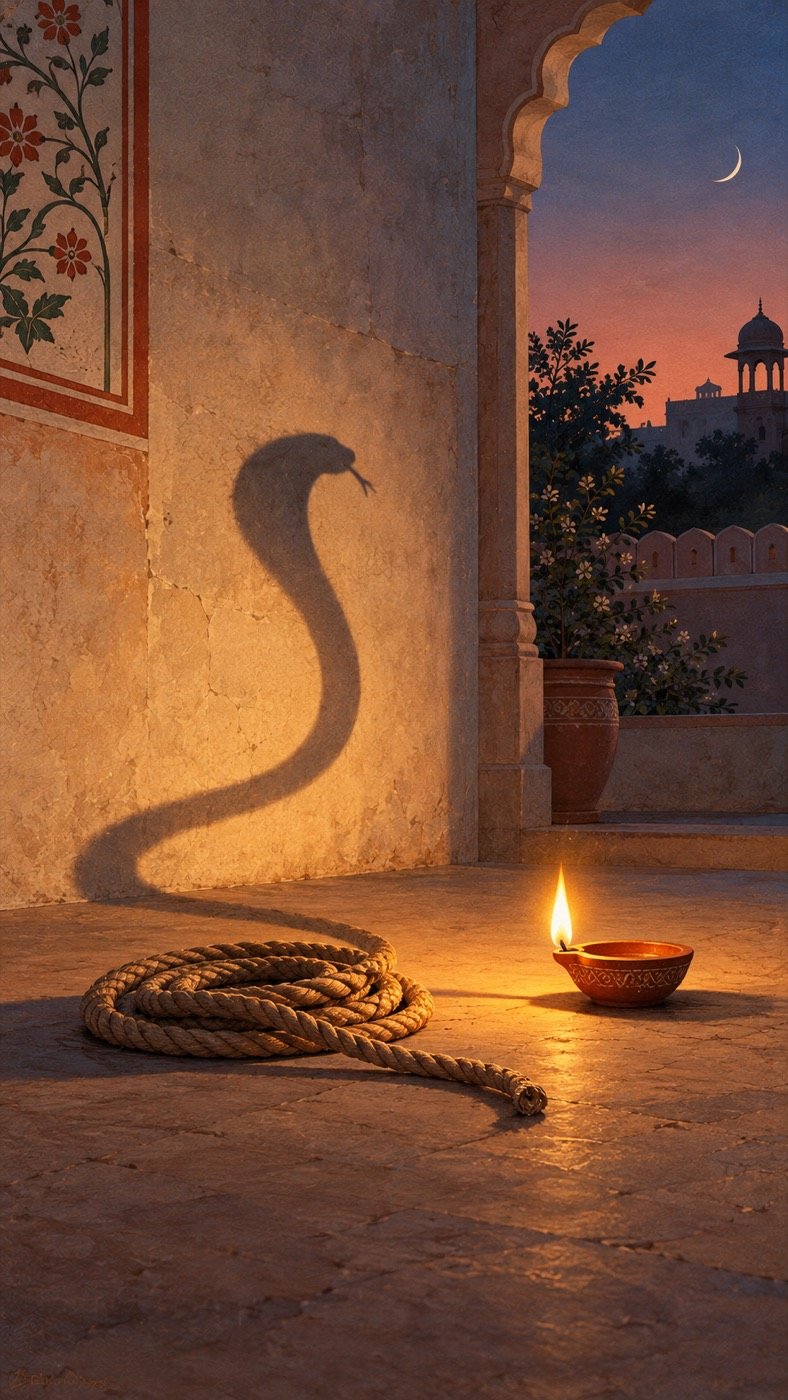
Advaita does not mean that a bus can pass through you or that another person’s pain is imaginary. The experienced world has empirical validity. What is denied is its independent, absolute status apart from Brahman. The term mithyā is therefore better introduced as dependent and open to sublation than simply as 'fake'. A mistaken snake disappears when a rope is recognised, while the experience of fear was real as an experience. This illustrates correction of a judgement, not an experimental demonstration that the universe is an illusion.
View of the Self
Ātman is awareness itself, not the autobiographical personality.
The empirical person remembers, chooses and acts. Advaita locates these functions in the body–mind complex rather than in the ultimate Self. Awareness is self-disclosing: even doubt is known in its presence. Inquiry asks whether anything that appears as an object—including the thought 'I'—can be the final subject. The conclusion is not that your personality is secretly omnipotent. It is that the distinction between this finite knower and limitless Brahman rests on limiting identification.
View of God
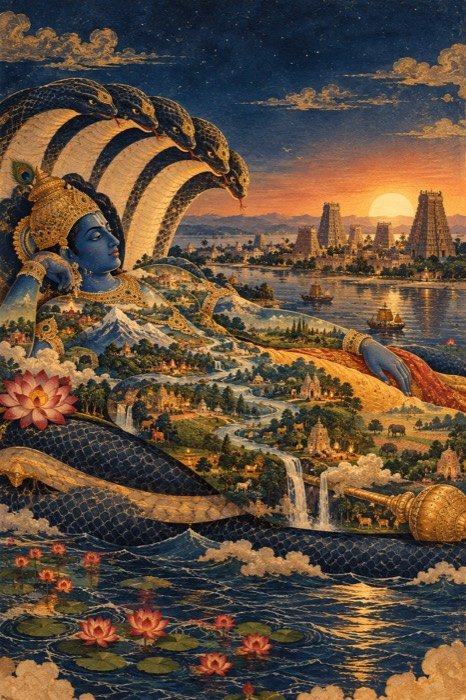
Īśvara is meaningful within empirical reality; ultimate Brahman is without limiting attributes.
Advaita recognises Īśvara, the Lord, as the intelligent order and cause of the experienced cosmos, and accepts devotion as a serious part of spiritual life. Nirguṇa Brahman does not possess finite qualities that would distinguish it from something else. Saguṇa Brahman is that same reality considered in relation to the world. These are not rival gods, and the distinction does not make devotion useless. It does, however, differ sharply from traditions that regard the eternal difference between God and soul as indispensable.
Cause of suffering
We seek lasting fulfilment in what changes because we misunderstand who we are.
Desire and fear intensify when the Self is identified exclusively with vulnerable possessions, status and mental states. Action under this misapprehension sustains karmic bondage and rebirth in the traditional account. Knowledge removes the fundamental error, while preparation addresses entrenched habits. This explanation is a philosophical and soteriological theory; it is not a reason to blame a person for illness, violence or poverty. Compassionate action remains appropriate within the empirical world.
Path to liberation
Disciplined listening, reasoning and contemplation are directed toward liberating knowledge.
The traditional sequence is śravaṇa: hearing or studying the Upanishadic teaching; manana: reasoning through doubts; and nididhyāsana: sustained contemplation that addresses habitual misidentification. Ethical steadiness, discernment, dispassion and concentration prepare the mind. Action can change circumstances or purify dispositions, but an action-produced result would be impermanent; therefore liberation, understood as one's already-present nature, is disclosed by knowledge. Reading a slogan and agreeing with it is not equivalent to the transformation described here.
Ethics and everyday life
Non-attachment is compatible with care, responsibility and non-harm.
Truthfulness, restraint and non-harm prepare the mind for inquiry. A practical application is to notice when a setback becomes a total verdict on your worth, then distinguish the event from the sweeping identity judgement. This is a reflective adaptation, not a translation of a prescribed classical exercise. Non-duality should never be used to dismiss consent, injustice or accountability. If all distinctions are called unreal to avoid responsibility, the empirical standpoint that makes teaching possible has been applied inconsistently.
A simple real-life analogy
Mistaking a rope for a snake shows how an error can cause real fear.
You enter a dim room, see a coiled rope and recoil. More force will not destroy the snake, because there is no snake there; better illumination corrects the perception. Advaita uses this kind of example to explain why knowledge, rather than the production of a new object, can remove a problem rooted in misapprehension. The comparison has a limit: ropes and snakes are already agreed empirical objects, while the status of the whole world is precisely what is disputed.
Arguments supporting the philosophy
Its strongest case joins the self-disclosure of awareness to an interpretation of the Upanishads.
First, all denial or doubt occurs within awareness, giving awareness an unusual epistemic status. Second, changing objects cannot supply an unchanging identity on their own. Third, Shankara reads Upanishadic identity statements as removing limited conceptions of self and ultimate reality. Together, these support a non-dual interpretation. The argument is strongest when its scriptural commitments are explicit. It is weaker when a modern advocate treats a moving experience of unity as sufficient proof of every metaphysical claim.
Criticisms and philosophical problems
Critics question the status of ignorance and the step from awareness to one reality.
If Brahman alone is ultimately real, what is ignorance, and whose ignorance is it? If ignorance is real, non-duality appears compromised; if wholly unreal, its explanatory role seems obscure. Advaitins respond with different accounts of its dependent and indescribable status. Realists also ask why successful public knowledge should be demoted, while Buddhists question whether a permanent witness adds an unnecessary substance. These are persistent philosophical disputes, not merely failures to understand the tradition.
Disagreements with other Indian schools
Buddhism questions a permanent self; other Vedānta schools defend real difference.
Vishishtadvaita treats individual souls and the world as real qualifications of Brahman, not ultimately sublatable appearances. Dvaita maintains eternal distinction between God, souls and matter. Samkhya posits many witnesses and an independent nature. Buddhist traditions reject an enduring ātman, although their accounts of cognition and ultimate truth vary. Kashmir Shaivism shares a non-dual emphasis but describes the world as the real manifestation of consciousness’s power. Similar language about liberation does not erase these disagreements.
Common misconceptions
Advaita does not teach that your ego is God or that nothing matters.
'I am Brahman' concerns the Self freed from limiting identification, not a claim that personal wishes govern reality. 'The world is mithyā' is not permission to disregard consequences. Nor is Advaita the meaning of every Upanishad accepted by all readers. Finally, a neuroscience result about attention does not verify non-dual metaphysics. Distinguishing these claims makes the tradition more philosophically interesting, because its actual arguments can be assessed rather than replaced by inspirational slogans.
Key thinkers
- Gaudapada — c. 6th–7th century CE; debated
- Adi Shankara — c. 8th century CE
- Sureshvara — c. 8th–9th century CE
Sanskrit and Pali terms
- Ātman
- Self; in Advaita, awareness that is not an object.
- Brahman
- The non-dual ground of reality, not the deity Brahmā.
- Avidyā
- Ignorance or misapprehension of the Self.
- Adhyāsa
- Superimposition: attributing the properties of one thing to another.
- Mithyā
- Dependent, sublatable reality; neither absolutely real nor sheer nonexistence.
- Mokṣa
- Freedom through knowledge of the identity of ātman and Brahman.
Sources and further reading
- University guideEnglish
Śaṃkara — IGNOU unit 12 (opens in a new tab)
IGNOU · public university, India
How to read itTeaching resource by S. Bhuvneswari on epistemology, metaphysics and liberation. A secondary introduction, not a primary scripture.
- Original textSanskrit, multiple scripts
Brahma Sutra and Śaṅkara’s commentary (opens in a new tab)
IIT Kanpur · public institute, India
How to read itRoot sūtras and a distinct Advaita commentary. Begin with 1.1.1–4; compare other Vedānta readings rather than treating this commentary as neutral.
- Original textSanskrit; available translations vary
Upanishads — IIT Kanpur heritage texts (opens in a new tab)
IIT Kanpur · public institute, India
How to read itFollow Upanishads from the institutional portal. Useful passages: Chāndogya 6.8–16, Bṛhadāraṇyaka 2.4 and 3.8, Katha 1.3. This is a collection entry, not a single manuscript.
- Original textSanskrit; English and Indian languages
Bhagavad Gita — Sanskrit with selectable translations and commentaries (opens in a new tab)
IIT Kanpur · public institute, India
How to read itChoose the Gita reader, then select the translator and commentator. Their interpretations differ. A commentary is not the root verse.