
Philosophy in one sentence
God, individual souls and matter are eternally distinct, with everything dependent on God.
Dvaita, developed by Madhva, identifies Viṣṇu as the only fully independent reality. Souls and matter are real and dependent, yet never become numerically identical to God. Liberation is a perfected relationship to the divine, not the disappearance of difference. The fivefold distinction between God, souls and material things is a foundational feature of this realist account.
Why it matters
It takes individuality, relationship and dependence seriously.
If liberation meant the end of all distinction, would love and responsibility still make sense? Dvaita makes enduring individuality part of its answer. It also challenges the idea that ordinary perception is fundamentally misleading about plurality. The modern reader can examine whether a dependent self can have authentic agency, and whether an ultimate relationship is more intelligible than the dissolution of a subject into a single reality.
Historical origin
Madhva established a powerful realist Vedānta in medieval Karnataka.
Madhva, also called Anandatirtha, worked in thirteenth-century South India and is closely associated with Udupi. His commentaries interpreted the shared Vedānta canon in opposition to non-dual readings. Jayatirtha and Vyasatirtha later developed sophisticated arguments in epistemology, metaphysics and polemics. The tradition became a major participant in later Sanskrit intellectual debate, rather than simply a devotional reaction to philosophy.
Central questions
What makes persons different, and can they be free while dependent on God?
Dvaita asks whether difference is directly known, whether a creator must remain distinct from creation, how the soul’s agency relates to divine control, and why souls experience unequal destinies. These questions are connected: its explanation of liberation depends on a durable person who knows and loves God. An account that dissolved individuality would change the meaning of the goal.
Core ideas
Five real differences structure the world of God, souls and matter.
Pañcabheda names differences between God and soul, God and matter, soul and soul, soul and matter, and one material thing and another. Viṣṇu alone is independent. Souls possess real individuality and are capable of knowledge, while their powers depend on God. Difference is not merely a temporary appearance caused by ignorance. Scriptural passages that appear to deny distinction receive contextual interpretations within this realist framework.
View of reality
The world is real; dependence does not make it an illusion.
Perceived things belong to an objective world, though perception can be mistaken in particular cases. God governs a cosmos with real matter and real temporal processes. The distinction between what is independent and what is dependent prevents the reality of the world from making it equal to God. This permits a strong realism while retaining theological sovereignty. A central burden is to explain why divine dependence is required in addition to ordinary causal explanations.
View of the Self
Each soul is enduring and remains distinct from every other soul.
A soul is a real subject of knowledge and experience, dependent on Viṣṇu but not identical to him. Liberation does not erase its identity. Madhva also teaches intrinsic differences and gradation among souls, a demanding doctrine for contemporary egalitarian readers. Explaining this feature honestly is essential: removing it to make the school more appealing would obscure a genuine point of philosophical controversy.
View of God
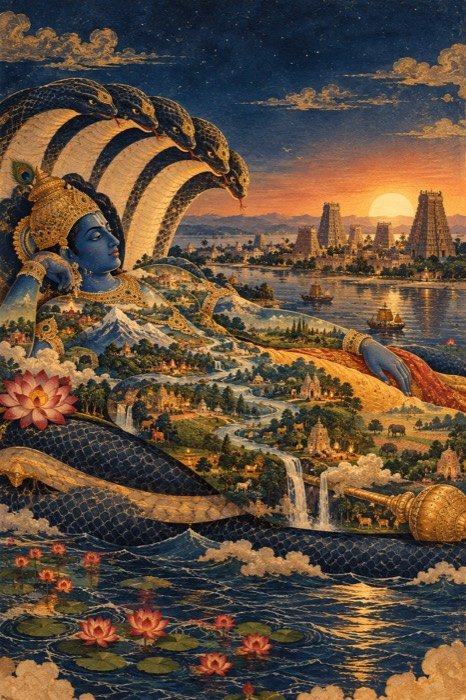
Viṣṇu is the independent supreme reality with unlimited auspicious qualities.
God is not an impersonal substrate temporarily imagined as personal. The Lord’s knowledge, power and perfection are intrinsic, and the distinction between God and the soul is never overcome. Devotion depends on recognising this asymmetry. Dvaita consequently challenges Advaita readings of nirguṇa: scripture denies defects or material limitations, rather than every positive quality. Divine grace is essential for release from bondage.
Cause of suffering
Ignorance, karma and misdirected action sustain bondage under divine governance.
Souls suffer because they are bound by karma and fail to understand their relation to God. Devotion and right understanding transform that relation, while release ultimately depends on grace. Since God governs the entire order, the system faces serious questions about evil, unequal opportunity and the fairness of different destinies. A philosophical account of karma should never be used as evidence that a particular sufferer deserved their circumstances.
Path to liberation
Knowledge of difference, devotion and grace lead to freedom without loss of identity.
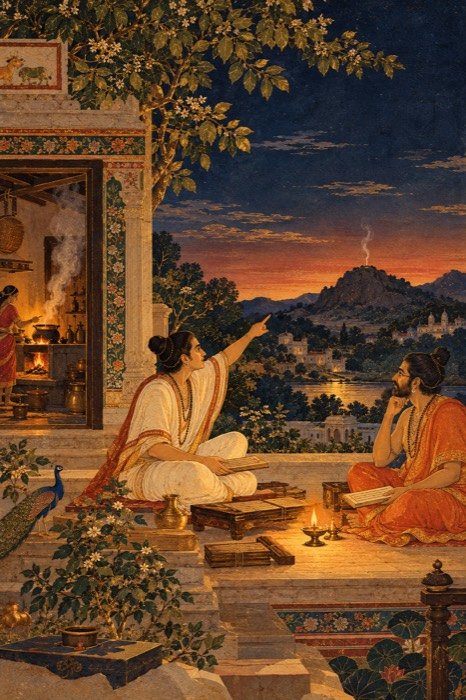
Study and disciplined conduct support knowledge of the Lord and the soul’s dependence. Bhakti is informed, enduring devotion, rather than a passing feeling. Liberation brings freedom from bondage and the joy of relationship with God, while individual difference remains. It is therefore not the same goal as an Advaitic account of non-dual recognition even if both use the word moksha.
Ethics and everyday life
Moral agency is real, even though its capacities depend on God.
A person’s decisions and their consequences matter because the person and world are real. Responsibility, devotion and service can orient ordinary work. A practical reflection is to identify the supports that make one's action possible without using dependence to evade accountability. Historical Dvaita institutions and social hierarchies should be discussed as part of their context, while a contemporary reader remains free to challenge their justification.
A simple real-life analogy
A musician can depend on a teacher without becoming the teacher.
Learning may require a relationship, resources and guidance; mastery does not make two persons numerically one. This contemporary analogy helps illustrate why dependence and fulfilment need not abolish individuality. It does not establish Dvaita’s theology: a human teacher is not the source of all capacities, and a student can outgrow that dependence. The difference between illustration and proof is especially important here.
Arguments supporting the philosophy
The reality of difference and the coherence of personal relationship support its case.
Ordinary knowledge appears to distinguish objects and subjects; denying all difference risks relying on the distinctions it rejects. Devotion and scriptural descriptions of divine perfection also seem to require an enduring distinction between worshipper and Lord. Dvaita combines these considerations with arguments for dependence on a supreme being. Its force lies in preserving realism and relationship. Opponents can still ask whether experience proves eternal difference or only difference at the empirical level.
Criticisms and philosophical problems
Divine control, unequal destinies and permanent hierarchy are difficult issues.
If God is both supreme and benevolent, why are some souls subject to radically different ultimate destinies? If dependence is complete, how can responsibility avoid collapsing into divine determination? If difference is eternal, how is it known to be eternal rather than merely stable within experience? Dvaita authors provide theological and epistemic responses, but these remain substantive disagreements. A fair presentation preserves their strongest replies without declaring the objections solved by faith alone.
Disagreements with other Indian schools
It rejects ultimate identity with Brahman while sharing Vedānta’s core textual sources.
Advaita reads key passages as teaching an ultimate identity that Dvaita rejects. Vishishtadvaita also preserves individual souls, but organises them as qualifications of one Brahman rather than Madhva’s distinct dependent realities. Nyaya offers useful realist allies but develops a different account of God, categories and cognition. Buddhist theories challenge the enduring soul itself. These are reasoned differences within and across textual communities.
Common misconceptions
Dvaita is not merely simple faith opposed to intellectual inquiry.
Madhva’s successors produced technically demanding philosophy. Their realism does not make every everyday judgement correct, and dependence on God does not straightforwardly mean that no human action matters. Dvaita should also not be conflated with Cartesian mind–body dualism: its central distinctions concern God, souls and matter within a different historical project. Finally, its controversial doctrines deserve explanation rather than either concealment or sensationalism.
Key thinkers
- Madhva — 13th century CE
- Jayatirtha — 14th century CE
- Vyasatirtha — 15th–16th centuries CE
Sanskrit and Pali terms
- Bheda
- Real difference.
- Pañcabheda
- Five kinds of fundamental difference.
- Svatantra
- Independent; fully applicable to God.
- Paratantra
- Dependent; the status of souls and the world.
- Tāratamya
- Hierarchy or gradation, including differences among souls.
- Bhakti
- Devotion grounded in knowledge of God and dependence.
Sources and further reading
- CommentarySanskrit transliteration
Brahmasūtra with Madhva’s Bhāṣya and Jagannātha Tīrtha’s Dīpikā (opens in a new tab)
GRETIL · Göttingen State and University Library
How to read itChapter 1, section 1. Root sūtras, commentary and later subcommentary are marked separately; based on the 1900 Madras edition.
- Original textSanskrit; English and Indian languages
Bhagavad Gita — Sanskrit with selectable translations and commentaries (opens in a new tab)
IIT Kanpur · public institute, India
How to read itChoose the Gita reader, then select the translator and commentator. Their interpretations differ. A commentary is not the root verse.
- University guideEnglish
Indian Metaphysics — IGNOU unit 2 (opens in a new tab)
IGNOU · public university, India
How to read itComparative teaching material spanning materialism, realism and Vedānta. Broad classifications simplify historical diversity.