Philosophy in one sentence
The received Charvaka view grounds consciousness in the living body and challenges claims about unseen worlds.
Charvaka or Lokayata names materialist currents that reject a disembodied surviving soul, a creator God and reliable knowledge of karmic afterlife rewards. Perception is central to their epistemic challenge. However, the evidence is fragmentary and frequently preserved by opponents. This guide therefore distinguishes the received doxographical portrait from claims we can securely attribute to individual materialists.
Why it matters
It shows that scepticism and materialism are also part of India’s intellectual heritage.
The idea that Indian philosophy is uniformly devotional or committed to rebirth excludes an important line of dissent. Charvaka asks what warrants promises about a world beyond experience and who benefits from ritual claims. Its challenge can sharpen the standards of every tradition, even if one rejects its conclusions. But an honest recovery of this voice must avoid replacing an opponent’s caricature with an equally unsupported modern hero.
Historical origin
Materialist positions survive mostly as fragments and reports in other traditions’ works.
Early Indian literature records positions denying an afterlife and explaining persons materially. Later doxographies present Charvaka as a recognisable school, often attributing founding teachings to Brihaspati. Purandara is known through fragmentary reports that suggest a more qualified treatment of inference. Jayarashi Bhatta’s Tattvopaplavasimha is relevant to scepticism, but his precise relationship to Charvaka is debated. There is no securely recoverable unbroken institutional history.
Central questions
Why believe in a soul, God or an afterlife that cannot be reliably demonstrated?
Can consciousness arise from bodily organisation? What justifies moving from observed regularities to imperceptible entities? Why should ritual specialists’ promises count as knowledge? What makes a good life if this embodied life is the relevant horizon? The questions concern evidence and human priorities. The surviving record does not support assigning one fully uniform answer to every historical materialist.
Core ideas
Material embodiment and scepticism about unverifiable claims define the received picture.
Doxographies commonly attribute reality to four perceptible elements and explain consciousness as arising from their organised combination. They deny the authority of the Veda and the survival of a separate soul after bodily dissolution. The exact scope of their rejection of inference is disputed. Some reports suggest acceptance of ordinary inferences while rejecting claims about radically unseen entities and consequences.
View of reality
The material world is the primary reality in the surviving accounts.
Bodies and objects consist of natural elements arranged in different forms. A supernatural maker or moral cosmic administrator is not needed to explain their occurrence. This is a philosophical naturalism, but its four-element framework is historically distinct from modern science. A contemporary materialist may find an ally in the general orientation while rejecting its particular cosmology and epistemic restrictions.
View of the Self
The person is embodied; consciousness does not establish a separable immortal soul.
The received account identifies the self with the conscious living body rather than an independent entity that merely inhabits it. Consciousness arises when elements combine in an appropriate way and ceases when that organisation is destroyed. This challenges the inference that because awareness differs in description from matter, it must exist apart from matter. The precise positive mechanism of consciousness is not preserved as a developed empirical theory.
View of God
Claims about a creator lack an adequate evidential basis in the materialist critique.
Charvaka rejects the need for a creator and challenges testimony offered as proof of divine authority. If a source’s reliability is precisely what is disputed, quoting it cannot settle the question without an independent reason to trust it. This critique targets both metaphysical explanation and the social authority attached to ritual knowledge. It does not mean every possible argument for God is refuted by the mere absence of direct perception.
Cause of suffering
Pain belongs to embodied life rather than proving a karmic debt or spiritual fall.
On the received view, suffering is part of the conditions of living bodies and social existence, not evidence of a previous life’s moral balance. Practical efforts to avoid pain and secure enjoyment therefore take priority over speculative promises of later reward. Our sources do not preserve a comprehensive Charvaka theory of structural injustice or mental health. It would be misleading to invent one in the name of modern relevance.
Path to liberation
Charvaka rejects the classical promise of release from rebirth as unsupported.
If no soul survives the body and no cycle of rebirth is established, liberation from that cycle is not a well-grounded goal. Attention turns toward this life rather than a transcendental final state. Some hostile accounts portray death as the only release, but such formulations should be handled as doxographical reports. A positive philosophy of worthwhile living must not be reconstructed solely from opponents’ jokes about pleasure.
Ethics and everyday life
A this-life orientation need not imply that every impulse should be followed.
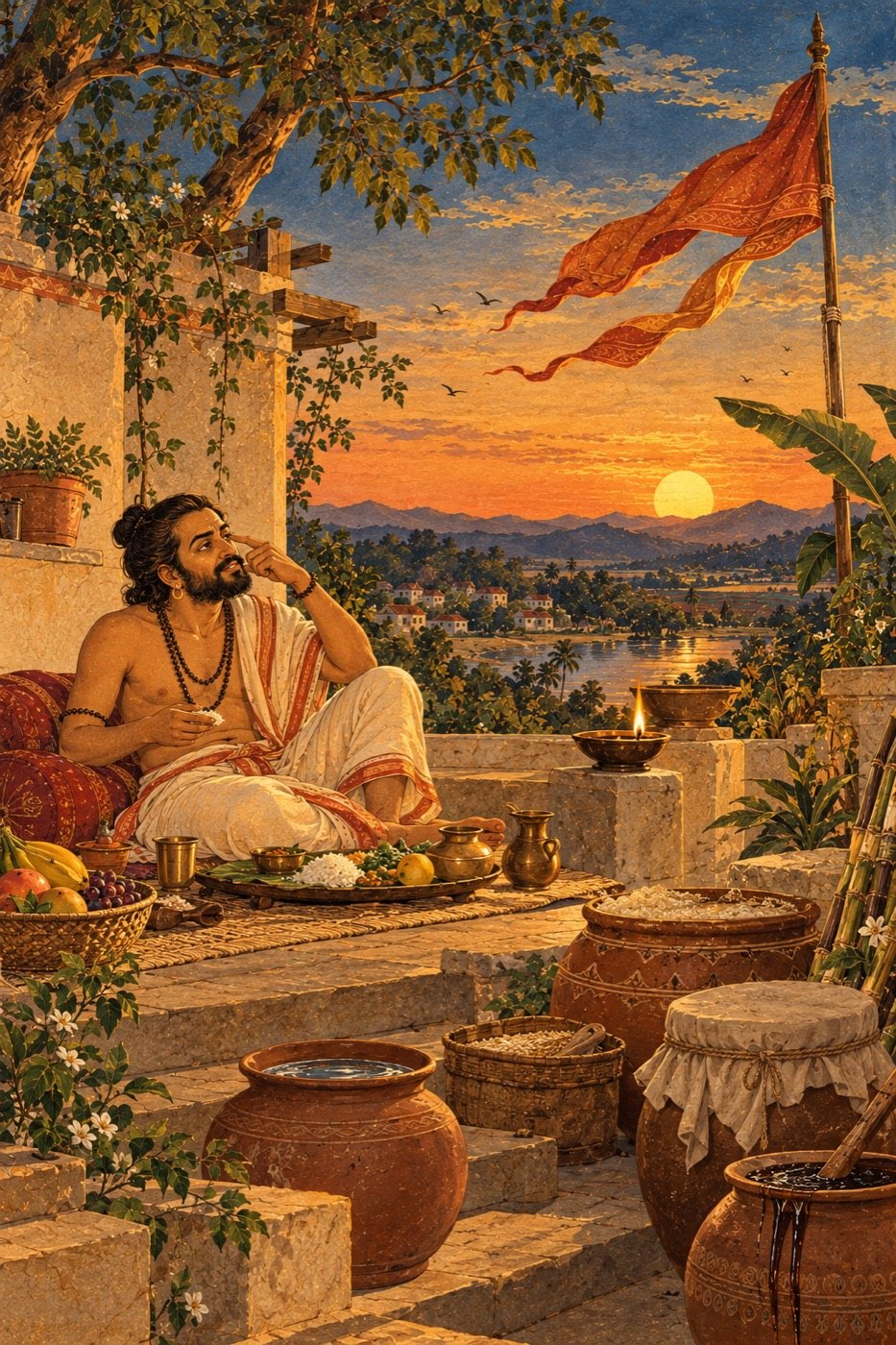
Pleasure and the avoidance of pain are prominent in accounts of Charvaka, but prudent concern for consequences can distinguish enjoyment from recklessness. Harm to others also affects a shared embodied world. The evidence does not justify attributing a complete modern utilitarian theory, nor does it justify assuming total moral indifference. We can ask how cooperation, care and long-term interests might be defended without an afterlife while clearly labelling that as contemporary analysis.
A simple real-life analogy
A property can appear in an organised whole without appearing in its isolated ingredients.
A prepared mixture may have a capacity its components do not separately exhibit. Doxographical accounts use such examples to explain how consciousness might depend on a living body. The analogy challenges a simple inference from 'the parts are not conscious' to 'the whole cannot be conscious'. It does not actually solve how experience arises or establish which organisation is sufficient.
Arguments supporting the philosophy
It presses the burden of proof for claims that go beyond available evidence.
The absence of reliable access to a disembodied self undermines easy assertions of immortality. Dependence of cognition on bodily conditions supports asking whether embodiment is sufficient. Contradictory religious testimony motivates scrutiny of authority. These considerations are strong challenges to overconfidence, but the conclusion that no unobserved entity exists would require more than showing that one argument for it fails.
Criticisms and philosophical problems
A strict rejection of inference may undermine the materialist’s own reasoning.
To infer that consciousness ends with bodily dissolution already seems to go beyond immediate perception. Everyday planning, memory-based expectation and knowledge of other minds also use inferential resources. If all inference is rejected, the position risks instability; if only some inferences are rejected, it needs a principled boundary. The fragmentary evidence makes it uncertain how particular materialists answered these objections.
Disagreements with other Indian schools
It challenges nearly every other school’s accounts of soul, scripture or liberation.
Nyaya defends reliable inference and argues for selves and God. Samkhya insists on consciousness distinct from nature. Vedanta grants the Upanishads a distinctive authority; Mimamsa defends supersensible ritual duty and results. Jain and Buddhist traditions reject a creator but retain karma and rebirth, so their non-theism does not make them materialists. These are substantial disagreements about evidence and the ends of life.
Common misconceptions
Charvaka is neither absent from Indian thought nor perfectly recoverable from a few quotations.
Its presence challenges a uniform picture of Indian spirituality, but its lost sources impose limits. Opponents’ accounts can preserve genuine doctrines while also distorting them. Jayarashi should not be casually installed as a spokesman for all Charvaka. And atheism by itself tells us little about a person’s ethics. The intellectually honest posture is to recover what the evidence permits and mark the rest as uncertain.
Key thinkers
- Brihaspati (traditional attribution) — Traditional attribution; no secure biography
- Purandara — Known through fragmentary reports
- Jayarashi Bhatta — c. 8th–9th century CE
Sanskrit and Pali terms
- Cārvāka / Lokāyata
- Labels associated with Indian materialist currents; their historical usage varies.
- Pratyakṣa
- Perception, accorded central authority in the received account.
- Dehātman
- The embodied self rather than an independent surviving soul.
- Bhūta
- Element; often earth, water, fire and air in doxographical accounts.
- Pramāṇa
- A means of knowledge, the topic of materialist criticism.
- Doxography
- An account of philosophical schools, often written from a rival standpoint.
Sources and further reading
- University guideEnglish
Indian philosophical views on the human person (opens in a new tab)
IGNOU · public university, India
How to read itComparative discussion including Charvaka and critiques of substantial selfhood. Accounts reported by opponents require caution.
- University guideEnglish
Indian Metaphysics — IGNOU unit 2 (opens in a new tab)
IGNOU · public university, India
How to read itComparative teaching material spanning materialism, realism and Vedānta. Broad classifications simplify historical diversity.