
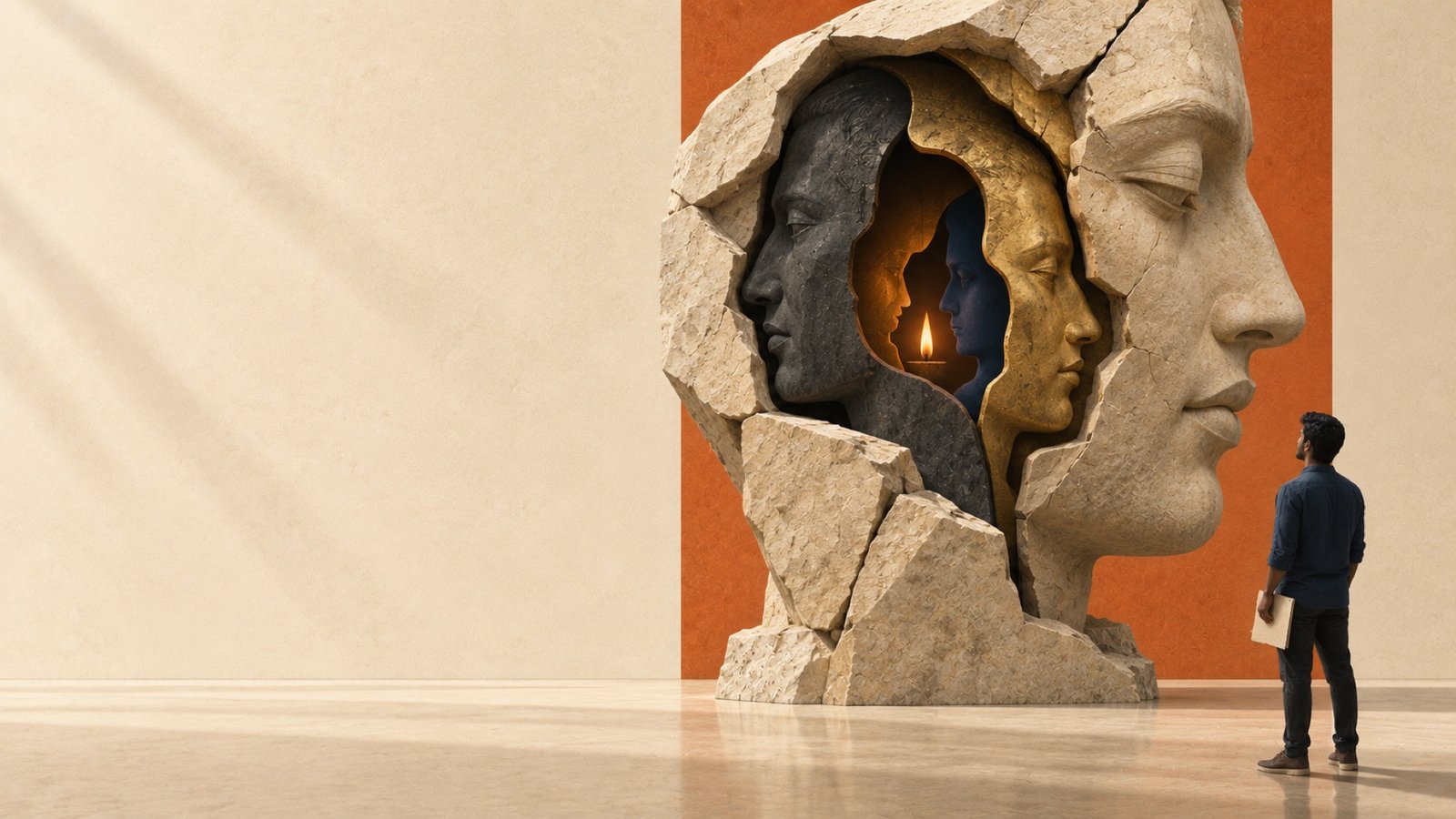
The familiar self is already a problem
Your body changes, memories fade, preferences evolve and roles end. A theory of self must explain how a person remains intelligible through those changes. Advaita and early Buddhism both question unexamined identification with the body and mental contents. That shared starting point can make them sound interchangeable. Their conclusions, however, differ in a way that matters.
The Advaitic proposal
Advaita distinguishes changing objects of experience from self-disclosing awareness. It interprets Upanishadic teaching as revealing that this Self is not ultimately separate from Brahman. The ego is not thereby promoted to divinity: the claim concerns awareness freed from limiting identification. Critics ask whether establishing awareness’s special epistemic status is enough to establish a single unchanging ultimate reality.
The early Buddhist challenge
SN 22.59 examines body, feeling, perception, formations and consciousness as impermanent and subject to affliction. None can be made to remain exactly as one wishes. Grasping them as a sovereign permanent self is therefore challenged. Buddhist philosophers subsequently develop accounts of continuity and agency without an enduring substance-self. Ordinary persons are not erased merely because a permanent owner is rejected.
Where the real disagreement lies
The issue is not whether people can feel calmer when they stop identifying with every thought. It concerns what explains experience and whether an unchanging subject is required. Advaitins ask what unifies and knows a changing stream. Buddhists ask whether invoking a permanent witness adds an entity without sufficient warrant. Both sides must make the inferential step explicit rather than rely on the emotional appeal of an experience.
Avoid the easiest false resolution
Saying that they are 'the same truth in different words' bypasses the question instead of answering it. A person may develop a modern synthesis, but should identify it as their own interpretive project. The historical traditions also contain internal diversity, so the next step is to choose an author, passage and argument rather than compare slogans.
A reading exercise
Read a short account of Advaita’s self, then SN 22.59. Write down what each text treats as changing, what it rejects as self, and whether it establishes anything beyond that rejection. Finally ask what would count as evidence against each interpretation. That exercise preserves both sympathetic understanding and critical distance.
Sources
- Original textSanskrit; available translations vary
Upanishads — IIT Kanpur heritage texts (opens in a new tab)
IIT Kanpur · public institute, India
How to read itFollow Upanishads from the institutional portal. Useful passages: Chāndogya 6.8–16, Bṛhadāraṇyaka 2.4 and 3.8, Katha 1.3. This is a collection entry, not a single manuscript.
- University guideEnglish
Śaṃkara — IGNOU unit 12 (opens in a new tab)
IGNOU · public university, India
How to read itTeaching resource by S. Bhuvneswari on epistemology, metaphysics and liberation. A secondary introduction, not a primary scripture.
- TranslationEnglish with parallel Pali available
SN 22.59 — The characteristic of not-self (opens in a new tab)
SuttaCentral · nonprofit textual repository
How to read itTranslation by Bhikkhu Sujato. Select the root-text view to read Pali. A foundational early Buddhist argument about the five aggregates.
- University guideEnglish
Indian philosophical views on the human person (opens in a new tab)
IGNOU · public university, India
How to read itComparative discussion including Charvaka and critiques of substantial selfhood. Accounts reported by opponents require caution.